My grassy brethren grow again
I hate being touched. Getting plucked, chewed into, peed on? No, there is nothing worse in this world than you minding your own business, then something decides: “Hey, look at that. Let’s touch that tree”.
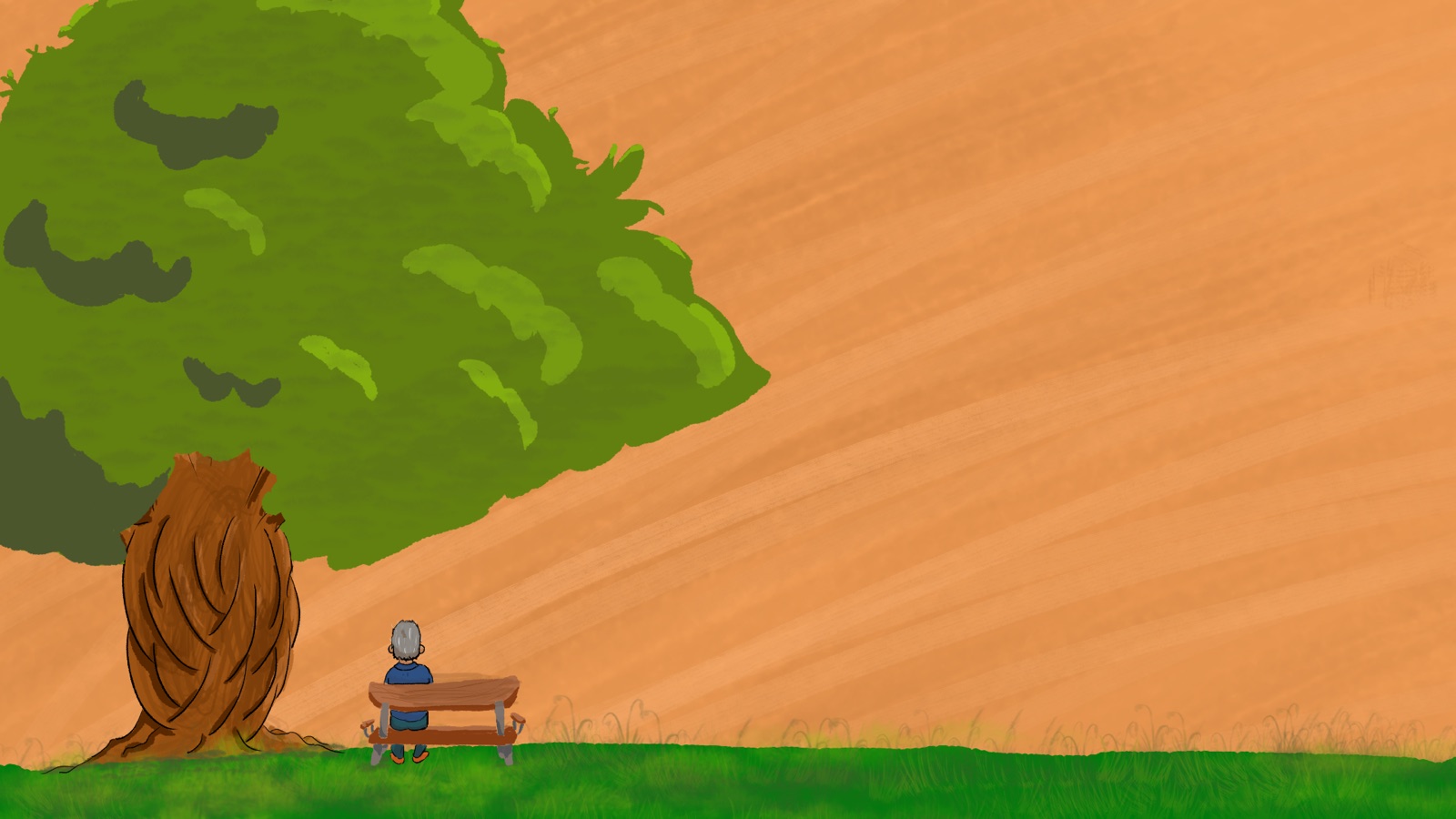
This makes it a very hard existence as I take up residence in a park by a bunch of houses and children. I did not choose to be here, but here I am. It is not a particularly large park, or at least, that’s what I think. I can easily see edge to edge, while all the other plants, flowers, foliage, and grass agree that this is probably a small park. I am the only tree in this domain, towering over all and taking root at the edge of it. After going to great lengths to grow and maintain my handsome canopy, the humans put a wooden bench under my shade. Guess the landscapers thought that having something else fibrous next to me would keep me company.
As I was saying, I hate being touched. Over the years, creatures keep insisting on laying their appendages on me. The twiggy legs of the birds, the pattering paws of the squirrels, but the humans. This one human. This one man. Every morning, just after the sun rises, he would lay his hand on me, and I cannot stand it. I did not have a choice, though, for I am a tree. I must stand. However! I was just soaking in the rays. I did not need his sweaty palm on me. It was always his left palm too. The one with the scar across his thumb to his middle finger, as if he had sliced it off before. Perhaps while touching something else he should not have been.
He would always come from the east edge of the park. I dreaded every time I felt the vibrations of his dusty orange shoes closing in on me. He would insist on defiling me, then continue onto the west exit of the park. It is like he has nothing better to do, like all he did was show up to annoy me. It would take him about an hour before he would return from the south of the park and make his way to the bench next to me, where he would spend the next quarter hour or so sitting there.
Unlike all the other humans that have come under my shade, he is nothing if not a persistent man. He has kept up this routine of touching me, walking off for an hour, then coming back and sitting down, for years. The little humans tend to stop showing up after a year or two, while the older ones will bring their dogs for a short while before I see them taking other routes or stop showing up altogether. He does look older, which I suppose would explain his ability to sit on the bench for stretches of time without looking at the bright rectangle.
I remember an autumn when my leaves were almost bare. The man stopped showing up. How typical, I thought. Just like all other humans, they move on eventually. The wind must have taken them elsewhere, as my seeds would have. I rejoiced that I would no longer need to feel his nubs on my trunk anymore as I braced myself for the cold. Oh, what a great feeling to not be shocked awake in the winter by that man.
But my joy only lasted until spring, when I once again felt the familiar yet slower steps from his dusty orange shoes inch closer to me before the surprisingly unfamiliar touch. His hand was thinner, almost like a larger bird’s feet. It made the scar more pronounced, a noticeable ridge that could have been missed before. He did not walk away this time. He sat down on the bench, taking in the cold morning air as his breath formed in front of him. This repeated for the next few weeks. Even though I could see that he was getting some heft back, his arms still slouched next to him, as if they were too heavy for his trunk.
I could not stand this sorry sight! If you are still going to lay your hand on me every morning, you might as well keep me entertained. Over those weeks, I grew a little seed just above his usual spot on the bench. His favourite spot, slightly to the right but never close to the rail. I dropped the seed early one morning, hitting him on the shoulder. He looked up at me with his grey eyes, tired and heavy. I remember thinking to myself if they’ve always looked like that or if I hadn’t seen his eyes much before this? I might have spotted a little smile on the corner of his lips, though I could not be sure. He has not emoted much over the many years of our acquaintanceship.
That did the trick, and I must take credit for it. From then on, we established a new routine. Every morning just after dawn, the man would come up to me from the east edge and place his hand on me as he usually does. He would then pace around me and the bench in an oval lap over and over again. After about 45 minutes or so, he would sit on the bench, and we would enjoy the bird songs together before he left.
We’ve kept up this routine for multiple rounds of children to grow from the swings to kicking their balls into my branches, which I realise that I also do not like, maybe more so than being touched. No matter how cold or wet it got and how deep a sleep I was in, his touch was familiar. Over time, his laps caused a trail where my grassy brethren compressed and eventually browned. The ring of destruction made me feel bad for the grass, but happy that the man was taking so much pride in maintaining it.
His pitter-patter grows as familiar as the grooves of his hand. I could feel them getting stronger again, back to when we first met. However, the length of his strides was also growing shorter. Some days, it would take him the same amount of time to cover fewer laps. It confused me as to why that was. Should I be dropping another nut on him? Other days, there was a pep in his step, though his time on the bench grew longer with each season.
It got to the point where his walks were only 10 minutes long. Even though the compressed ring of dead grass still formed around me and the bench, I could feel my grassy brethren’s roots taking hold again.
But he stopped. One winter day, like before, he stopped showing up. Maybe it was the cold, I thought one morning as I waited for his touch. The thought was quickly shuffled away; he was not the kind of man who would break our routine for the cold. I kept trying to convince myself that it was no big deal. He has disappeared before, long ago, and all humans eventually stop coming to the park as frequently. I kept feeding these thoughts to myself, while also catching myself stretching my branches further, to see more of the park, to see if he would come back.
He did come back. Two weeks later, he came back. It was an early spring morning; my branches filled with little nubs where the leaves would grow again. The sun was not even up yet. I was shocked awake by the unfamiliar vibrations on the ground. I did not recognise him at first. I could not feel him walking.
He pushed himself into the park in a wheelchair, though still with those dusty orange shoes on. Each motion of his arms propelled him forward. Each push of the wheel was methodical, graceful, and writhing with pain and anger. His grey eyes were sunken deeper into his saggy face, dark bags underneath. His skin also had more dark spots, all around, patching around the little folds. As usual, he parked himself next to me and put his hand on my trunk. His touch was thin and weak, unlike before.
Unlike before, he did not let go. He kept his hand on me as we watched the sun rise together. I could see his breath. His hand was trembling. He was crying. His sobs were quiet. His hand was still on me; I felt every tremble as the sun bathed us in its warmth.
It was only a half hour before a lady came rushing toward him, calling for him. He moved slowly; the tears were still there. He turned to her and forced a smile, hand still on me. The lady, much younger, spoke to him kindly and softly. I could still feel his hand trembling. His scar found its way neatly between the ridges of my trunk. His fingers curled a bit to hold me tighter.
As she tried to wheel him away, his fingers held on tighter, though he was not as strong as before. Knowing that he could not hold on, he gave me a couple of pats before he could no longer reach me. His fingers slipped as he was taken away, but his eyes, still watery, were fixed on me. I tried to drop a nut on him, but I had none to give.
Reluctantly, my grassy brethren grow again